Introduction: Choosing Stone Is a Commercial Decision, Not a Design Preference
For large-scale projects, stone selection is not about taste. It is about risk, longevity, maintenance cost, logistics, and claim exposure.
Importers, wholesalers, and developers sourcing stone in bulk need to answer practical questions:
- Will this material survive the climate?
- Can it be replaced batch-to-batch?
- How much wastage should I budget?
- What complaints will I get after installation?
This guide compares granite, marble, and quartz from a B2B procurement and export perspective, not a showroom brochure angle.
Natural Stone vs Engineered Stone: The Core Difference
Before comparing materials, one distinction matters more than anything else.
Natural Stone
- Mined directly from quarries
- Each slab is geologically unique
- Variations in color, veining, and grain are unavoidable
- Includes: Granite, Marble, Limestone, Sandstone
Engineered Stone
- Manufactured using crushed stone and resins
- Controlled color and pattern consistency
- Predictable performance
- Includes: Quartz surfaces
If your buyer expects visual uniformity across thousands of square meters, this distinction alone may decide the purchase.
Granite: The Workhorse of Global Construction Projects
What Granite Is
Granite is an igneous natural stone formed under extreme pressure. It is dense, hard, and mechanically stable.
Why Granite Dominates Bulk Projects
Granite is favored in commercial flooring, exterior cladding, high-traffic public areas, and industrial and infrastructure projects.
Reasons:
- High compressive strength
- Low water absorption compared to other natural stones
- Strong resistance to abrasion and impact
Granite from a B2B Sourcing Perspective
Advantages:
- Long service life
- Suitable for indoor and outdoor use
- Strong resale acceptance in global markets
- Wide availability from India, Brazil, and Africa
Challenges:
- Color and grain variation between blocks
- Requires batch planning for large orders
- Higher weight impacts freight cost
Granite is forgiving in performance but unforgiving if you ignore block selection and shading control.
Marble: Premium Appeal with Structural Sensitivity
What Marble Is
Marble is a metamorphic stone derived from limestone. It is softer than granite and more chemically reactive.
Where Marble Makes Commercial Sense
Marble is commonly used in luxury residential projects, hotels and hospitality, premium lobbies and feature areas, and decorative wall cladding.
Marble from a B2B Risk Perspective
Advantages:
- High perceived value
- Premium aesthetics
- Strong demand in Middle East and Europe
Challenges:
- Higher water absorption
- Sensitive to acids and chemicals
- Prone to scratching and etching
- Higher rejection risk during installation
Marble is not a maintenance-free material. Buyers who treat it like granite usually regret it.
Quartz: Engineered Consistency for Predictable Supply Chains
What Quartz Is
Quartz surfaces are engineered stone, typically composed of 90 to 95 percent crushed quartz, polymer resins, and pigments and additives.
Why Developers Choose Quartz
Quartz dominates kitchens, bathrooms, standardized residential units, and projects requiring visual uniformity.
Quartz from an Importer's Perspective
Advantages:
- Uniform color and pattern
- Low porosity
- Easier quality control
- Lower replacement risk
Challenges:
- Limited outdoor suitability
- Heat sensitivity
- Resin content varies by manufacturer
- Less tolerance for UV exposure
Quartz behaves more like a manufactured product than a stone. That predictability is its biggest strength.
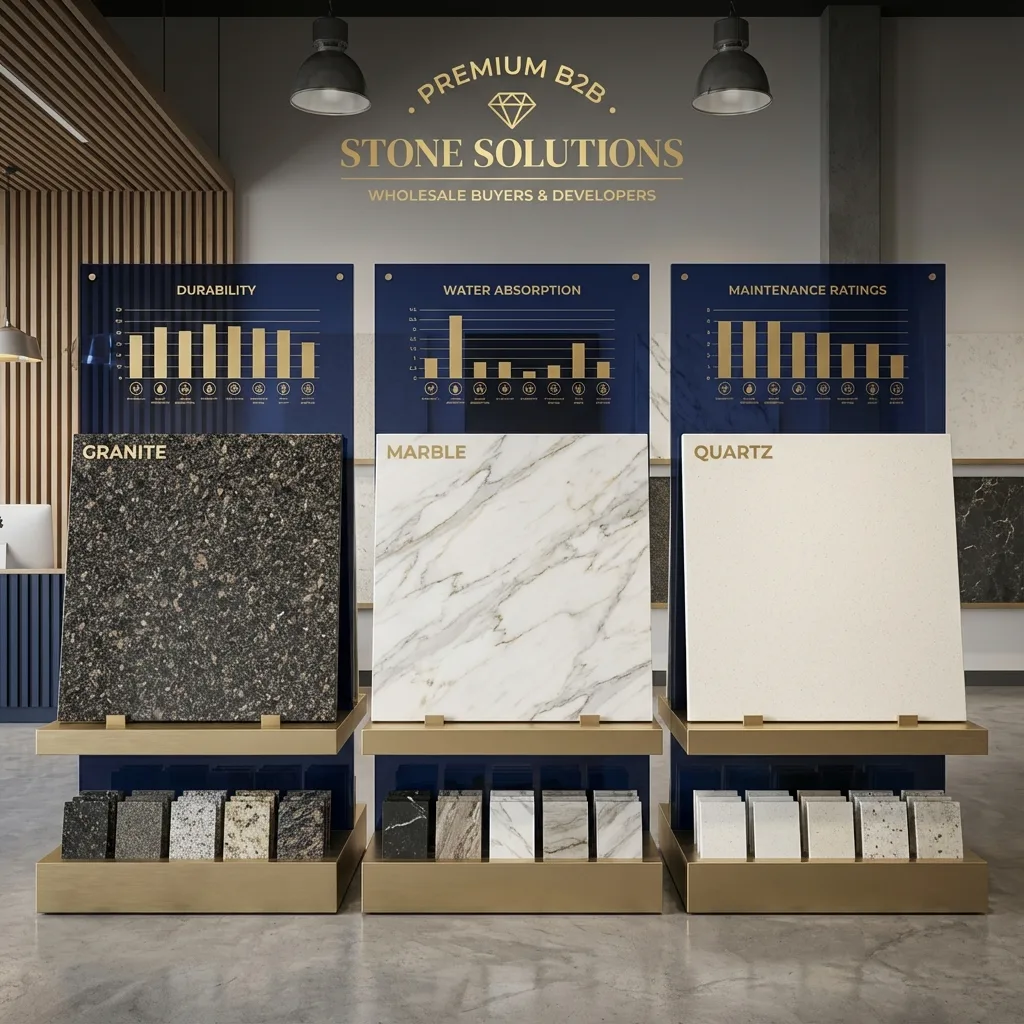
Granite vs Marble vs Quartz: Side-by-Side Comparison
| Parameter | Granite | Marble | Quartz |
|---|---|---|---|
| Type | Natural | Natural | Engineered |
| Durability | Very high | Medium | High |
| Water Absorption | Low | Medium to high | Very low |
| Aesthetic Consistency | Medium | Low | Very high |
| Maintenance | Low | High | Low |
| Outdoor Use | Excellent | Limited | Not recommended |
| Bulk Supply Predictability | Medium | Low | High |
If you are supplying multiple sites across different cities, quartz or granite usually wins on logistics alone.
Logistics, FOB/CIF, and Supply Chain Considerations
This is where many buyers miscalculate.
Natural Stone Logistics
- Heavy weight increases freight cost
- Breakage risk during container loading
- Requires proper crate packing and lashing
- FOB pricing often hides inland logistics costs
Engineered Stone Logistics
- More standardized packing
- Better container optimization
- Lower rejection rates at destination
- Predictable CIF costing
In bulk export, supply chain stability often matters more than raw material price.
Common Buyer Mistakes in Stone Procurement
Let's be direct.
- Choosing marble for high-traffic commercial flooring
- Ignoring batch control in granite
- Assuming all quartz manufacturers use the same resin quality
- Underestimating freight impact on landed cost
- Mixing aesthetic expectations with structural realities
Most disputes do not come from defects. They come from wrong material selection.
How We Support B2B Buyers Across Stone Categories
As a B2B export trader, our role is to align material choice with project reality. We support granite, marble, limestone, and sandstone sourcing, batch selection and shading control, bulk slab and tile supply, FOB and CIF export coordination, quality checks before dispatch, and long-term supply planning.
We also complement natural stone with large-format porcelain slabs, marble and stone-effect porcelain tiles, and wall tiles for volume-driven projects. This allows buyers to balance aesthetics, cost, and logistics under one supply umbrella.
Conclusion: The Right Stone Is the One That Reduces Your Risk
Granite, marble, and quartz are not competitors. They are tools.
- Granite solves durability and outdoor performance
- Marble delivers premium visual impact with higher care
- Quartz provides consistency and supply chain efficiency
The wrong choice increases claims, delays, and reputation damage. The right choice protects margins and timelines.