Introduction: Granite Slab Type Is a Supply Chain Decision
Many buyers think slab selection is about thickness and polish. That is wrong.
In bulk granite sourcing, the choice between gangsaw slabs and cutter slabs directly affects slab size availability, joint planning on site, cutting yield, consistency across containers, and landed cost under FOB or CIF terms.
Misunderstanding this difference leads to excessive wastage, mismatch during replacement, and disputes between installer and supplier.
What Defines a Granite Slab?
Before comparing processes, clarify what a slab actually is. A granite slab is a primary processed product, cut directly from a quarry block. How that block is cut determines slab size, thickness tolerance, surface behavior during polishing, and suitability for large-format applications.
There are two dominant industrial cutting methods: Gangsaw cutting and Cutter (multi-blade or block cutter) cutting. Everything else flows from this choice.
Gangsaw Slabs: Large Format, High Precision, High Planning
What Is Gangsaw Cutting?
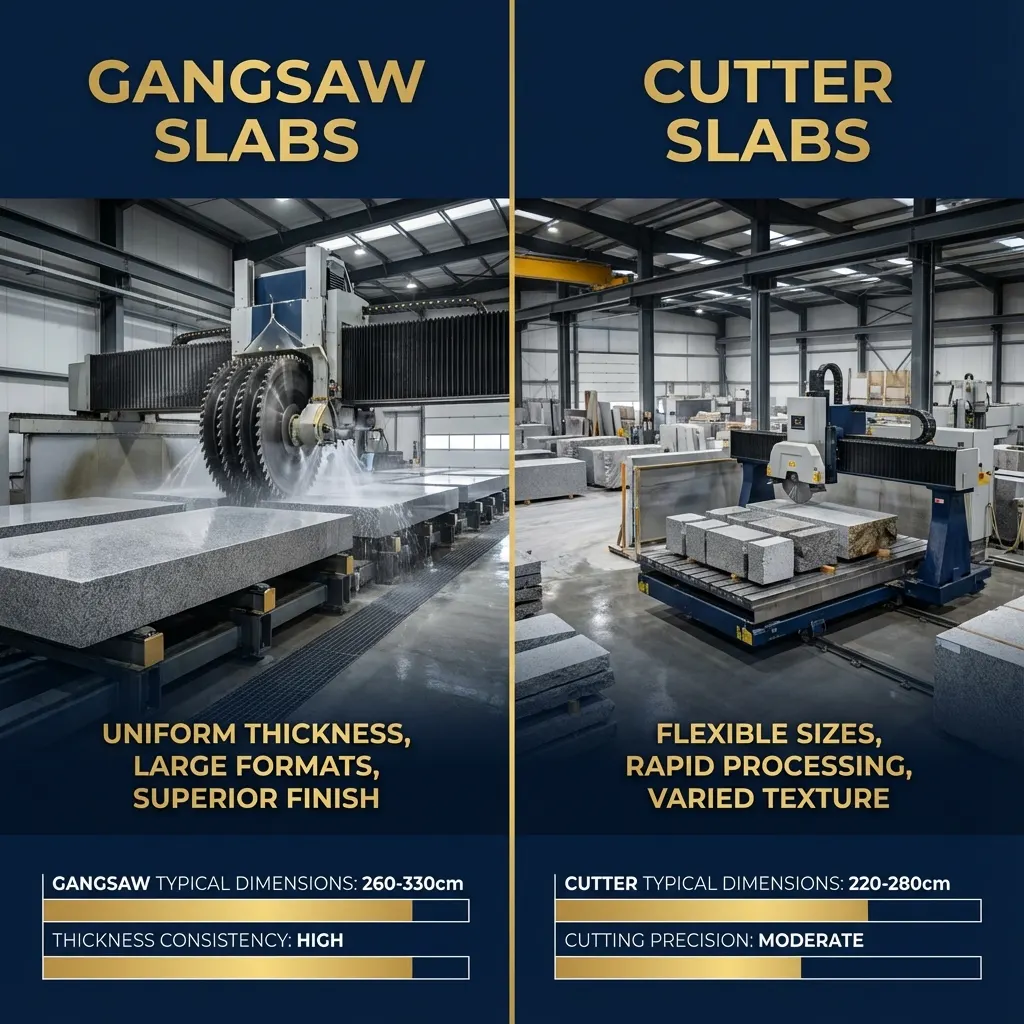
A gangsaw uses multiple parallel steel blades to slice a granite block simultaneously into slabs. This is a slow, controlled, industrial process designed for maximum slab size and uniformity.
Typical Gangsaw Slab Sizes
While exact sizes vary by block, gangsaw slabs are usually:
- Length: 260 to 330 cm
- Height: 160 to 200 cm
- Thickness: 18 mm, 20 mm, 30 mm (tight tolerance)
These are the slabs architects and developers prefer when they want fewer joints and cleaner layouts.
Performance Characteristics of Gangsaw Slabs
Advantages:
- Larger slab sizes
- Better thickness consistency
- Superior polish retention
- Ideal for book-matching and vein continuity
- Higher acceptance in premium commercial projects
Limitations:
- Higher processing cost
- Longer lead times
- Requires high-quality blocks
- Not economical for all granite varieties
Gangsaw slabs are not about speed. They are about precision and predictability.
When Gangsaw Slabs Make Commercial Sense
- Airports and large public buildings
- Premium commercial flooring
- Hotel lobbies and corporate interiors
- Projects requiring visual continuity
- Buyers planning multi-container programs
If joint minimization matters, gangsaw is usually the correct choice.
Cutter Slabs: Flexible, Cost-Efficient, Volume-Driven
What Is Cutter Slab Processing?
Cutter slabs are produced using block cutters or multi-blade machines that cut one block at a time, faster and with more flexibility than gangsaws. This is the most common method used for mass-market granite production.
Typical Cutter Slab Sizes
Cutter slabs are generally smaller:
- Length: 220 to 280 cm
- Height: 120 to 160 cm
- Thickness: 18 mm to 30 mm (wider tolerance)
Exact sizing depends heavily on block shape, machine calibration, and operator skill.
Performance Characteristics of Cutter Slabs
Advantages:
- Lower processing cost
- Faster production cycles
- Suitable for a wider range of blocks
- Ideal for price-sensitive markets
Limitations:
- Smaller slab sizes
- Higher thickness variation
- Less consistency across lots
- More joints required during installation
Cutter slabs are about efficiency and volume, not perfection.
Where Cutter Slabs Are Commonly Used
- Residential projects
- Small to mid-scale commercial buildings
- Countertops and vanities
- Markets where price competitiveness dominates
Cutter slabs work well when design tolerance is higher.
Gangsaw vs Cutter Slabs: Side-by-Side Comparison
| Parameter | Gangsaw Slabs | Cutter Slabs |
|---|---|---|
| Average Slab Size | Larger | Smaller |
| Thickness Consistency | High | Medium |
| Cutting Precision | Very high | Moderate |
| Processing Cost | Higher | Lower |
| Lead Time | Longer | Shorter |
| Best For | Large projects | Volume markets |
| Joint Requirement | Minimal | Higher |
| Batch Consistency | High | Medium |
If your project has tight tolerances, cutter slabs will eventually expose that weakness.
Impact on Yield, Wastage, and Costing
This is where procurement reality hits.
Yield Differences
- Gangsaw cutting maximizes usable slab area per block
- Cutter cutting often sacrifices size for speed
- Irregular blocks perform better in cutter machines
Wastage Planning
- Cutter slabs increase joint-related wastage on site
- Gangsaw slabs reduce cutting loss during installation
- Replacement slabs are easier to match with gangsaw programs
The cheapest slab per square meter often becomes the most expensive after installation.
Logistics, FOB/CIF Pricing, and Container Planning
Slab type affects export logistics directly.
Gangsaw Slabs
- Heavier individual slabs
- Fewer pieces per container
- Higher per-piece value
- Lower rejection rate on arrival
Cutter Slabs
- More pieces per container
- Easier container optimization
- Higher handling damage risk
- Greater variation during unloading
FOB pricing hides many of these realities. CIF pricing exposes them quickly.
Common Buyer Mistakes in Slab Selection
Let's be blunt again.
- Ordering cutter slabs for large seamless flooring
- Expecting cutter slabs to match gangsaw samples
- Ignoring thickness tolerance in cutter production
- Mixing gangsaw and cutter slabs in the same project
- Selecting slab type based purely on price
Most slab disputes are process misunderstandings, not quality failures.
How Slab Choice Affects Long-Term Replacement
This is rarely discussed, but critical.
- Gangsaw programs allow better future replacement matching
- Cutter slabs vary more from lot to lot
- Projects needing future expansion should avoid cutter slabs
- Infrastructure projects almost always specify gangsaw
If replacement matters, gangsaw should already be on your checklist.
Conclusion: Choose the Cutting Method That Protects Your Project
Gangsaw slabs and cutter slabs are not competing products. They are tools for different commercial objectives.
- Gangsaw slabs deliver size, consistency, and precision
- Cutter slabs deliver speed, flexibility, and cost efficiency
The wrong choice increases installation complexity, wastage, replacement difficulty, and long-term project risk.
At Aleron Ceramic, we help B2B buyers choose the right granite slab processing method based on project scale, budget logic, and supply chain realities. Our sourcing across granite, marble, limestone, sandstone, and large-format porcelain allows buyers to balance performance, aesthetics, and logistics under one export framework.