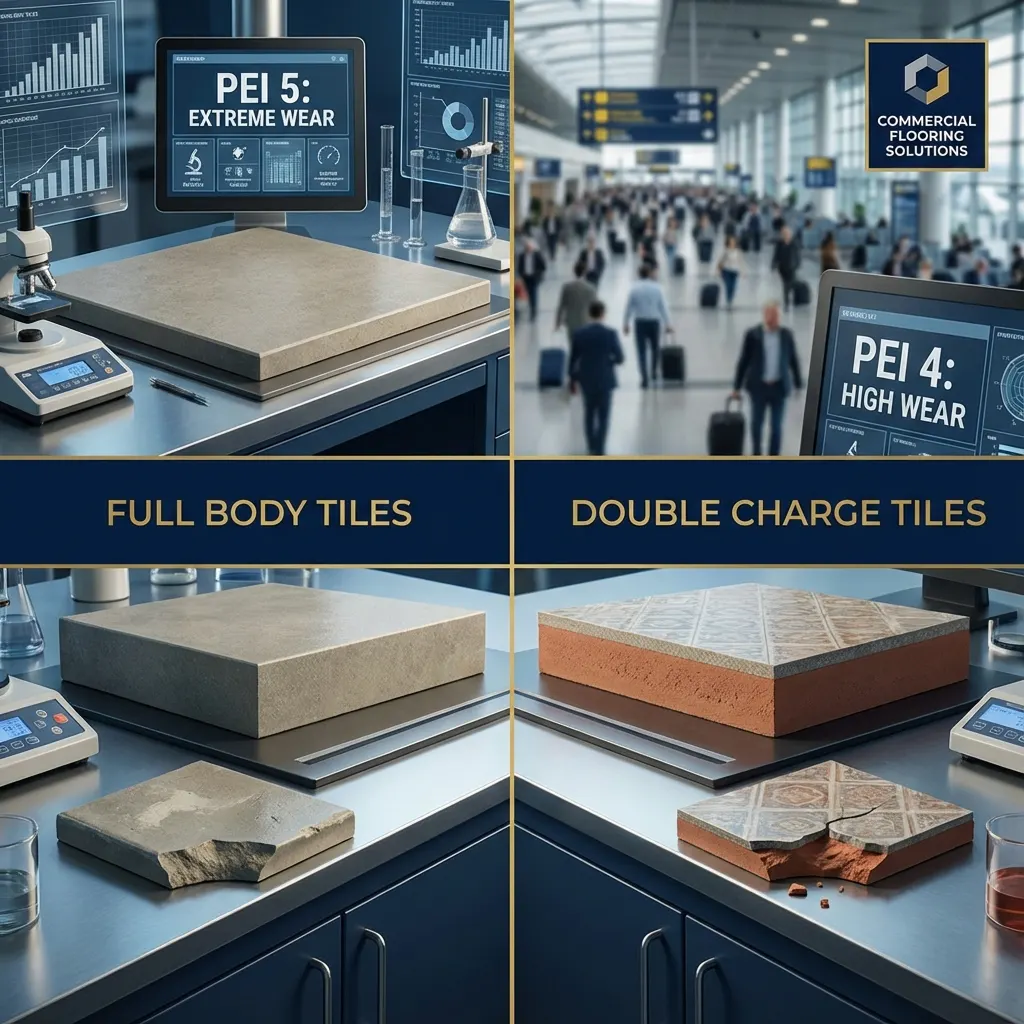
For importers, wholesalers, and large-scale developers, the choice between full body and double charge tiles is a procurement decision with direct consequences for lifecycle cost, warranty claims, and on-site downtime. You are buying not just surface finish but a performance specification that will be trodden on daily by tenants, shoppers, guests, or factory workers. This guide cuts through marketing noise, compares the two technologies by measurable criteria, and gives a pragmatic B2B checklist so you can confidently bulk source the right tile for high-traffic applications while protecting margins and timelines.
Quick definitions: what procurement teams must know
- Full body tiles (also called through-body tiles) are manufactured so the body and the surface have the same composition and color. Wear removes the same material, so chips and scratches are much less visible. Full-body tiles are valued for consistent durability.
- Double charge tiles are produced by pressing two layers of dry mix: a body layer and a decorative layer (the "double charge") on top. The top layer contains pigments/designs and results in a thick, wear-resistant surface that's especially good for uniform patterns and deep colour saturation. They are engineered for abrasion resistance and cost-effective performance in heavy-footfall zones.
Decide tiles by technical specs, not just labels.
Performance comparison: abrasion, chip resistance and longevity
Abrasion resistance is the single most important performance metric for high-traffic floors. The industry-standard PEI rating — measured via a controlled abrasion test — should be your first checkpoint. For malls, airports, and commercial corridors, insist on PEI 4 or 5 and request third-party test certificates.
Full body tiles: Because color and material are consistent through the thickness, they hide deep abrasion and edge chips better. This makes them a dependable choice where mechanical impacts or heavy trolleys are expected.
Double charge tiles: Designed specifically to resist surface wear because the upper decorative layer is thicker and compacted during pressing. They can deliver excellent abrasion resistance and uniform appearance, often at a lower cost than premium full-body porcelain. Use them when you need high wear resistance with consistent visual patterns.
Practical rule
Require WA% (water absorption), PEI class, and breaking strength from every supplier. If a vendor resists lab reports, treat them as high risk.
Visual stability and batch consistency: why it matters at scale
Batch-to-batch variation is a major cause of claims when importing by the container. Full body tiles are inherently more forgiving when a small chip exposes the core because the exposed color matches the surface. Double charge tiles, while wear-resistant, can show more pronounced differences if batch IDs are mixed and the top layer shade varies.
Procurement move
Enforce batch matching and request batch IDs, slab maps (where applicable), and pre-shipment pallet photos to ensure continuous runs for floors larger than one container load.
Installation and on-site durability: handling, joints, and lifecycle costs
Both tile types require correct installation practices — but full-body tiles give a slightly wider margin for error in very heavy-duty environments (warehouses, industrial loading bays) because chips don't show as clearly. Double charge tiles are excellent for commercial retail and offices where abrasion is mainly foot traffic and light trolleys.
Key contract items to include in your RFQ:
- Acceptable substrate tolerance (mm)
- Grout joint spec and movement joint plan
- Specified adhesive and recommended installer certification
- Site handling requirements (suction lifters for large formats, minimum crew size)
These procedural clauses prevent disputes and reduce warranty claims.
Cost vs value: a CFO's view
Upfront unit price often favors double charge tiles versus top-tier full-body porcelain. But true procurement ROI comes from total cost of ownership:
Cost elements to model: unit price, expected maintenance/cleaning, repair frequency, replacement risk, and downtime cost during replacements.
For luxury lobbies and feature floors where appearance is core to asset value, polished full-body porcelain may justify premium pricing. For vast retail expanses or corridors, double charge often delivers the best balance of durability and landed cost.
Ask suppliers for real-world abrasion case studies or reference projects to validate total-cost claims.
Conclusion — which should you choose for high-traffic areas?
If your project prioritizes ultimate chip-forgiveness and you're handling mechanical impacts or very heavy loads, full-body tiles typically offer the safest margin for error. If you need high abrasion resistance, consistent patterning, and cost-effective performance across large retail or hospitality areas, double charge tiles are often the smarter bulk sourcing choice.
Either way, don't buy on label alone — buy on PEI, WA%, batch control, and export-grade packing. Verify with lab certificates and insist on pre-shipment visuals.
Contact our export desk for a bulk quotation, sample crates, and a trial container plan. We handle FOB/CIF pricing, container load optimization, and export-grade packing to protect your margins and timelines.