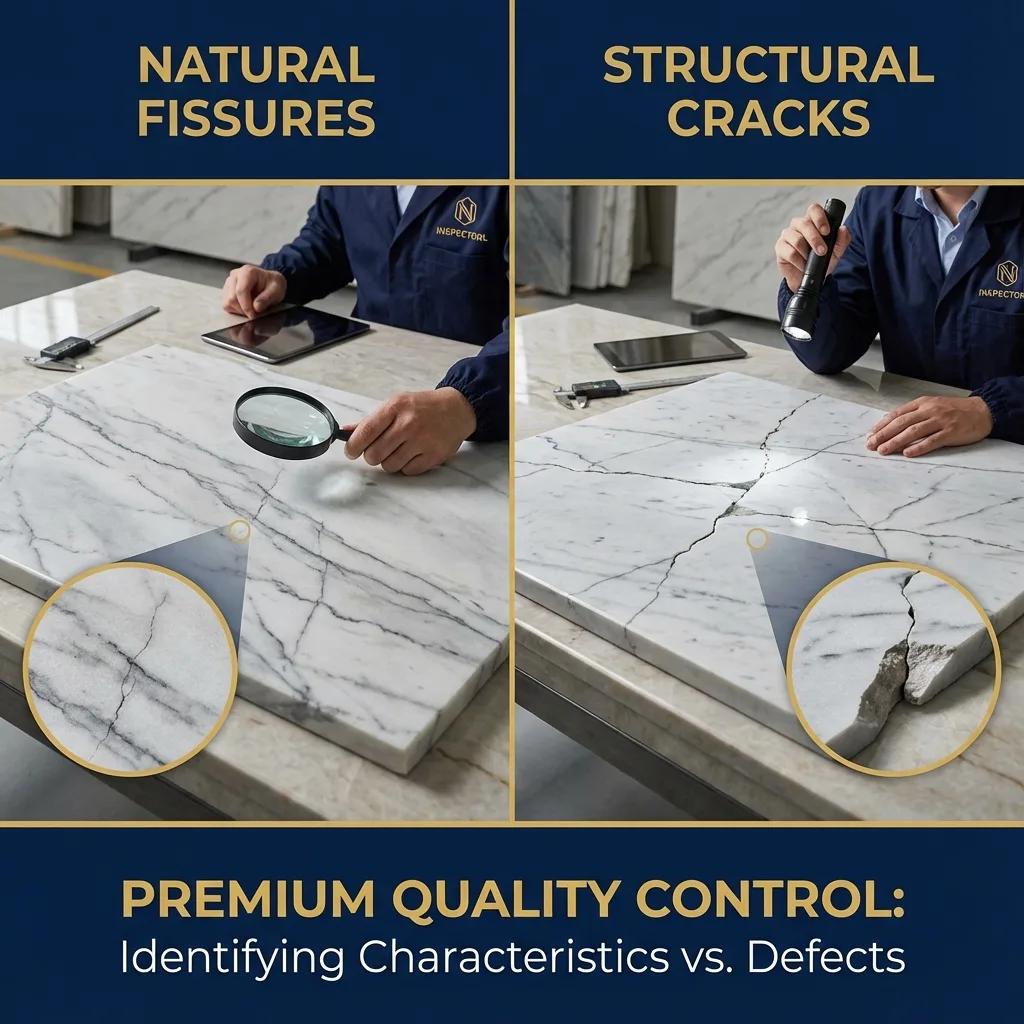
Introduction: Most Stone Disputes Begin with Misidentification
In global stone trade, few issues cause more conflict than the words "fissure" and "crack." To an experienced stone professional, the difference is clear. To an untrained inspector or first-time buyer, both look like defects.
This misunderstanding leads to shipment rejections at destination, delayed payments, insurance claims denied, broken supplier relationships, and costly legal arguments over "quality."
Natural stone is not manufactured perfection. It is a geological product shaped by millions of years of pressure, heat, and mineral movement. Veining, fissures, and natural lines are part of its identity. The real skill lies in knowing what is acceptable natural character and what is structural failure.
Why Understanding Fissures vs Cracks Is Critical in Bulk Trade
In small retail quantities, disputes can be solved with replacement. In container-scale exports, replacement is rarely practical.
For importers, wholesalers, and developers, misidentifying fissures as cracks creates installation delays, inventory deadlock, reputational damage with clients, and financial loss due to rejected material.
From a supply-chain perspective, the ability to distinguish between natural characteristics and defects is not optional. It is a commercial competency.
What Are Fissures in Natural Stone?
Fissures are natural separations or hairline openings within stone that occur during geological formation. They are not breaks caused by external stress.
Fissures often appear along mineral boundaries or veining patterns. In many granites and marbles, they are completely normal and expected.
Importantly, fissures do not compromise the structural integrity of the stone when properly processed and installed. In many cases, fissures are filled with resin during processing to enhance surface continuity and performance, especially in marble and limestone.
What Are Cracks in Natural Stone?
Cracks are structural fractures caused by mechanical stress, improper handling, cutting, transport vibration, or impact.
Unlike fissures, cracks interrupt the stone's continuity, propagate under stress, weaken structural performance, and often worsen during installation or use.
Cracks are defects. Fissures are characteristics. The problem is that visually, the two can appear similar to untrained eyes.
Visual Differences: How to Identify Fissures vs Cracks
Fissures usually follow natural vein lines, mineral flow, or grain patterns. They often appear as fine, irregular lines that blend into the stone's overall movement.
Cracks, on the other hand, tend to cut across grain or veining patterns unnaturally. They often look sharper, more linear, and more disruptive.
A fissure looks like it belongs. A crack looks like it was forced. This visual intuition improves with exposure, which is why inexperienced inspectors often misjudge.
Tactile and Sound Tests: Practical Field Identification
Experienced inspectors do not rely only on sight. A light tapping test using a coin or metal object often reveals the difference. Stone with fissures produces a solid, consistent sound. Stone with cracks often produces a dull or hollow response.
Running a fingernail across the surface also helps. Fissures are usually sealed or smooth after resin treatment. Cracks often catch the nail or feel sharp.
These simple tests are more reliable than magnified photos sent over email.
Structural Behavior Under Stress
This is the ultimate differentiator. Fissures do not propagate under normal handling or installation stress. Cracks do.
During cutting, transport, or installation: fissured slabs remain intact, cracked slabs worsen. This is why cracked stone often passes factory inspection but fails during unloading or fabrication.
A fissure is stable. A crack is unstable.
Role of Resin Filling in Fissures
In many export-quality marbles, limestones, and some granites, resin treatment is standard practice. Resin fills natural fissures and micro-porosities to improve surface strength, enhance polish, reduce water absorption, and stabilize natural features.
Buyers unfamiliar with stone processing sometimes assume resin indicates poor quality. In reality, resin filling is often a quality-enhancing process, not a defect mask.
However, resin does not fix cracks. It only stabilizes natural fissures. If resin-filled lines reappear or widen, that indicates an underlying crack, not a fissure.
Fissures, Veining, and Aesthetic Expectations
Natural veining is often the reason buyers choose stone in the first place. In marble especially, veins are expressions of mineral movement. Fissures often align with these veins, adding depth and authenticity.
Rejecting fissures indiscriminately often means rejecting the very character that differentiates natural stone from porcelain or engineered surfaces. Professional buyers align aesthetic expectations with geological reality.
Differences by Stone Type
Granite generally contains fewer visible fissures due to its dense, crystalline structure. When fissures appear, they are usually along quartz or feldspar boundaries.
Marble commonly exhibits fissures along veining, especially in dramatic varieties. These are normal and expected in export-grade material.
Limestone and sandstone, being sedimentary stones, often show natural bedding lines and fissures that are integral to their character. Understanding stone-specific behavior prevents incorrect blanket rejection criteria.
Inspection Stage: When Fissures vs Cracks Should Be Identified
Identification must happen before shipment, not at destination. Pre-shipment inspection is the last realistic moment to accept natural characteristics, reject true defects, and align expectations.
Waiting until arrival almost always turns technical discussion into commercial conflict. Inspection reports should clearly differentiate: natural fissures acceptable as per sample, and structural cracks unacceptable. Vague inspection language creates disputes.
Common Buyer Mistakes Around Fissures and Cracks
Most problems follow predictable patterns.
- Buyers approve one "clean" showroom sample and expect bulk shipments to match that unrealistic standard
- Rely on photos instead of physical inspection
- Appoint inspectors without stone-specific experience
- Change acceptance criteria after shipment, usually due to pressure from end clients or consultants
Stone does not change after shipping. Expectations do.
How Acceptance Criteria Should Be Defined in Contracts
Professional buyers define acceptance criteria in advance. This includes acknowledging presence of natural fissures, defining unacceptable crack behavior, referencing approved samples or mock-ups, and aligning inspection standards.
Contracts that say "no cracks" without defining fissures invite interpretation conflicts. Clarity protects both buyer and supplier.
Commercial Impact of Misclassification
Misclassifying fissures as cracks results in rejected containers, blocked inventory, strained supplier relations, and lost future pricing leverage.
Suppliers remember unreasonable buyers. So do markets. Experienced buyers build credibility by understanding material realities.
Conclusion: Natural Stone Quality Requires Geological Literacy
Natural stone is not defective because it is imperfect. It is valuable because it is natural.
Fissures are part of stone's geological story. Cracks are damage. Knowing the difference is a core skill in international stone procurement.
At Aleron Ceramic, we help B2B buyers source granite, marble, limestone, and sandstone with clear alignment on natural veining, acceptable fissures, and true defect identification. Our inspection and export process focuses on preventing misunderstandings before containers leave the port, not explaining them after arrival.